
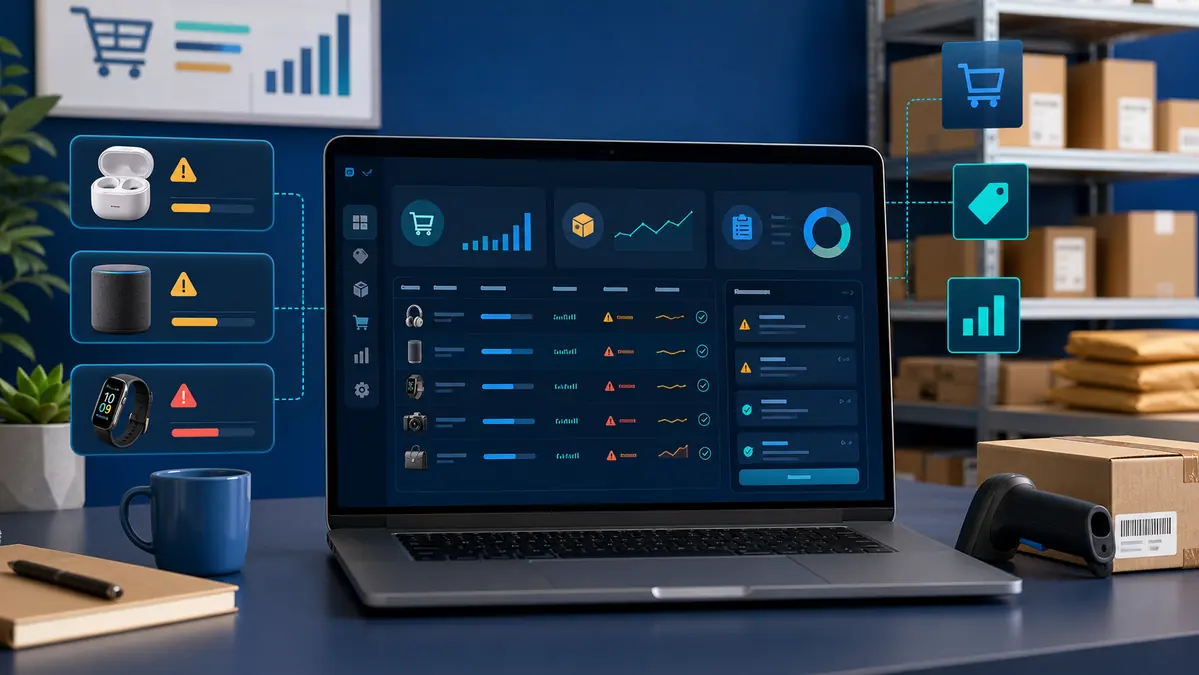
eBay stock monitoring software is useful when your live listings depend on supplier stock that can change before your team notices. The risky moment is not the order itself. The risky moment is the gap between the supplier running low and your eBay listing still looking safe.
For small sellers, that gap may be covered by manual checks. Once the catalog grows, manual checking turns into a guessing game. The seller needs a repeatable way to connect supplier stock, eBay quantities, SKU mapping, and review decisions before customers buy products that cannot be fulfilled.
What eBay stock monitoring software should do
A useful tool should show which eBay listings are attached to supplier sources, which sources changed, and which listings now need action. It should also separate "out of stock" from "low stock" because those states need different decisions.
The best workflow gives the seller a queue: products with supplier stockouts first, low-stock products next, failed supplier checks after that, then mapping issues. That queue is more useful than a dashboard full of numbers because it tells the operator where to start.
Why supplier-led eBay sellers need this
Many eBay sellers do not hold every unit in their own warehouse. They rely on suppliers, wholesalers, marketplace sources, or mixed supplier and warehouse stock. If the supplier source changes, the eBay listing needs to be reviewed quickly.
A supplier can change availability, remove a variation, update a pack size, or block the source page. If your system treats that silence as "everything is fine," overselling risk grows quietly.
The signals worth tracking
Do not track only one quantity field. Track the signals that affect whether the listing can safely keep selling:
- Supplier stock moved to zero or unavailable.
- Supplier stock crossed a low-stock threshold.
- The supplier check failed or returned uncertain data.
- The eBay variation is mapped to the wrong supplier option.
- The listing is live on eBay but has no trusted supplier source.
- The current eBay quantity is higher than the safe supplier quantity after buffers.
Approval-first updates are safer
Some sellers want stock changes pushed automatically. That can work after mappings and rules are trusted, but approval-first monitoring is the safer first stage. The software detects the problem and proposes an action. The seller reviews the recommendation before changing a live eBay listing.
This matters most for high-volume items, variation listings, bundles, and products where a bad pause or quantity change could affect revenue. A review queue gives the team speed without giving up judgment.
Where Zelluvo fits
Zelluvo is built for approval-first stock and price control. It helps sellers connect source URLs, SKUs, supplier stock, and proposed actions so the daily workflow becomes "review what changed" instead of "manually check everything."
For eBay sellers, that means fewer blind quantity decisions and a cleaner path from supplier signal to listing review.
Related Zelluvo guides
- how to prevent overselling when suppliers go out of stock
- low-stock alerts and inventory buffers
- SKU mapping for ecommerce automation
A practical workflow for the first week
Do not start by trying to automate every decision around eBay stock monitoring software. Start by building a clean review routine. Pick the products that create the most risk: best sellers, thin-margin items, unreliable supplier sources, variation-heavy listings, and products with previous cancellations.
On day one, confirm the source relationship for those products. On day two, review low-stock thresholds and buffers. On day three, check whether price changes affect margin. By the end of the week, the team should know which products are safe, which need review, and which should not be automated yet.
This first-week rhythm is useful because it produces evidence. You can see whether sources fail, whether mappings are trusted, and whether alerts are useful or noisy. That is the kind of operating knowledge a generic feature checklist cannot give you.
Common mistakes to avoid
Most problems with eBay stock monitoring software come from moving too fast before the catalog is clean. Watch for these mistakes:
- Treating a parent product as safe when the exact variation is unavailable.
- Letting every supplier change update a live listing without review.
- Using one low-stock threshold for every product, regardless of sales velocity.
- Ignoring failed source checks because no stockout alert appeared.
- Forgetting that supplier price changes can create margin risk even when stock is healthy.
- Buying broad software before the team has a daily review process they can actually run.
What to measure after 30 days
After a month, look at outcomes rather than dashboard activity. Count how many risky products were caught before an order, how many supplier failures were reviewed, how many mappings were fixed, and how often proposed changes were approved without manual recalculation.
Also track alert quality. If the team ignores half the queue, the rules are too noisy. If cancellations still happen because products were missed, the rules are too loose or the mappings are incomplete. Good monitoring gets sharper over time because the workflow teaches you where the catalog is fragile.
Use the results to decide whether to expand the workflow into more products, more channels, or deeper automation. Zelluvo's related feature page at /features/multichannel-stock-management is the commercial next step for sellers who want to turn this process into a repeatable system.
FAQ
Is eBay stock monitoring software only useful for large sellers? No. Smaller sellers benefit when a few stockouts or margin mistakes can wipe out profit for the week. The value is not catalog size alone; it is how expensive a missed supplier change can be.
Should updates be fully automatic? Not at first for risky products. Approval-first workflows are safer while you are still proving mappings, thresholds, supplier reliability, and price rules.
Where should a seller start after reading eBay Stock Monitoring Software: How Sellers Catch Stockouts Before Orders? Start with the 20 products most likely to create customer or margin problems. Map them cleanly, monitor them daily, and expand only after the alerts are accurate enough for your team to trust.